
Linux is open source. The kernel can be inspected. Programs can be compiled independently. Firewalls can monitor incoming and outgoing network traffic.
At least, that is what we tend to assume.
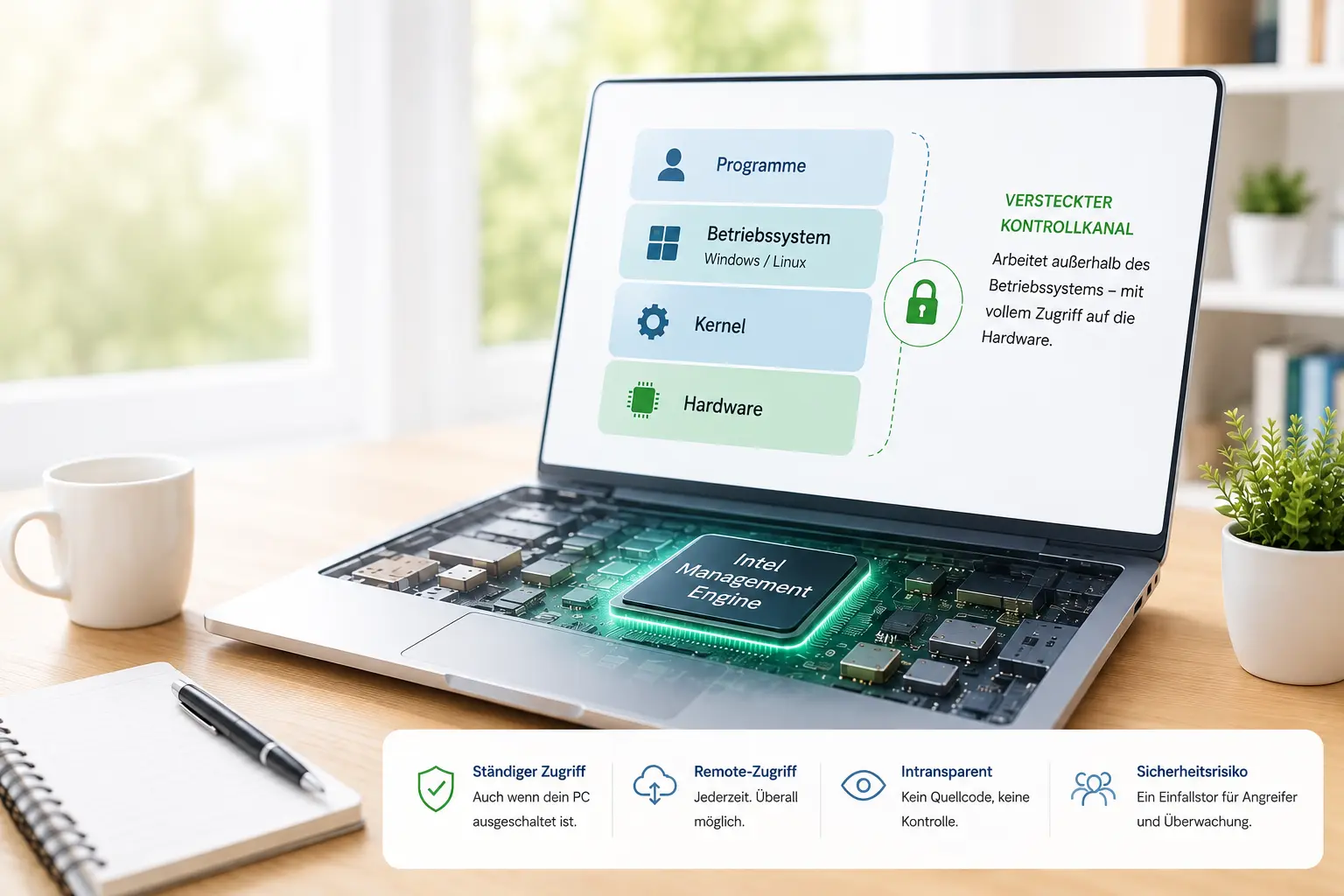
Deep below the operating system, however, many Intel systems contain another, largely invisible world: the Intel Management Engine, now part of the Intel Converged Security and Management Engine (CSME).
It operates independently of the main operating system, has extensive privileges, and its firmware is proprietary. On appropriately equipped systems, Intel Active Management Technology (AMT) even provides network communication outside the normal host operating system.
This raises an uncomfortable question:
Can a computer really be considered trustworthy if its owner cannot control all of the software controlling its hardware?
A Computer Inside the Computer
The Intel Management Engine is not an ordinary Windows or Linux application.
It is part of the platform and operates outside the normal host operating system.
In simplified terms, a PC does not merely look like this:
Applications
    ↓
Linux / Windows
    ↓
Kernel
    ↓
Hardware
A more accurate simplified picture is:
                 Applications
                      ↓
                Linux / Windows
                      ↓
                    Kernel
                      ↓
         ┌────────────┴────────────┐
         │                         │
      Host CPU                 ME / CSME
         │                         │
         │                  Own firmware
         │                         │
         └────────────┬────────────┘
                      ↓
                   Hardware
This means that a privileged software component exists that an ordinary user cannot control like a normal service.
And that is precisely what makes it interesting from a security perspective.
MINIX in the Machine Room
In 2017, one discovery attracted considerable attention: certain generations of the Intel Management Engine used an adapted version of MINIX 3.
MINIX is not merely a small hardware driver. It is a genuine operating system based on a microkernel architecture.
This does not mean that every Intel PC runs an ordinary, complete MINIX installation with all of its familiar services. Intel uses a specially adapted firmware environment.
Nevertheless, it illustrates the scale of what we are dealing with.
This is not simply a few hundred bytes of initialization code.
It is a complex execution environment deep inside the platform.
And It Can Communicate
Things become particularly interesting with Intel systems supporting vPro and Active Management Technology (AMT).
AMT was developed for remote administration of corporate computers.
Administrators can manage appropriately configured machines independently of the normal operating system. Depending on the platform and configuration, capabilities may include:
- powering a computer on or off,
- restarting it,
- retrieving hardware information,
- Serial over LAN,
- remote KVM,
- storage or media redirection,
- diagnosing a computer whose operating system no longer works.
This is the purpose of out-of-band management.
A corporate network should still be able to reach a computer even when Windows or Linux is no longer functioning.
In simplified form:
                    Network
                       │
                       ↓
                Network controller
                   /         \
                  /           \
                 ↓             ↓
             ME / AMT      Host system
                 │             │
            Management       Linux
                               │
                            Firewall
For large companies, this can be extremely useful.
But it also has a remarkable consequence:
Not every form of network communication available to such a platform necessarily has to pass through the networking stack of the host operating system.
A Linux firewall controls what Linux controls.
It cannot automatically guarantee that another component outside its own trust domain is not communicating.
Does That Make Intel ME a Backdoor?
No.
At least, there is no publicly established evidence proving that Intel ME was developed as a secret intelligence-service backdoor.
This is where a serious analysis must distinguish clearly between:
demonstrated capabilities
and
conclusions that could be drawn from them.
The fact that a technology could theoretically be used for surveillance or sabotage does not prove that it was designed or is actually being used for that purpose.
But that does not make the underlying problem disappear.
From a computer-security perspective, there is a more fundamental question:
Why should I have to trust Intel at all?
The Black Box Inside Your Own Computer
Linux can be inspected.
The Linux kernel has publicly available source code.
The same applies to GCC, Clang, and countless other components of a free operating system.
In principle, their source code can be examined, modified, and independently compiled.
With a proprietary platform component, the situation is different.
The owner does not automatically possess a complete, verifiable chain such as:
Source code
    ↓
Audit
    ↓
Reproducible build
    ↓
Binary
    ↓
Executed firmware
A black box therefore exists inside the system’s Trusted Computing Base.
This explicitly does not mean that something malicious must be hidden inside it.
It means something more fundamental:
The owner cannot fully verify its absence independently.
Ken Thompson Sends His Regards
The problem recalls one of the most famous observations in computer science.
Ken Thompson, one of the creators of Unix, described an extraordinarily elegant attack in his 1984 lecture “Reflections on Trusting Trust.”
Imagine a manipulated C compiler.
It recognizes when it is compiling a login program:
if compiling(login.c)
    insert_backdoor();
Of course, an auditor could discover this manipulation in the compiler source code.
So Thompson goes one step further.
The manipulated compiler also recognizes when it is compiling the compiler itself:
if compiling(compiler.c)
    insert_compiler_backdoor();
Now both manipulations can be removed from the visible source code.
The compiler remains infected.
When the apparently clean compiler source is compiled again, the already manipulated compiler recreates the manipulated compiler.
clean compiler source
          │
          ↓
manipulated old compiler
          │
          ↓
manipulated new compiler
          │
          ↓
clean source
          │
          ↓
manipulated compiler again
Eventually, the backdoor exists nowhere in the visible source code.
Thompson’s message went far beyond this particular attack:
Somewhere, trust has to begin.
And today we encounter the same problem again at the hardware level.
Open Source Alone Is Not Enough
Even a completely free operating system does not solve the trust problem entirely.
You might have:
Firefox
   ↓
Open Source

Linux
   ↓
Open Source

GCC
   ↓
Open Source

coreboot
   ↓
largely Open Source
But beneath these layers there may still be:
CPU microcode

SSD controller firmware

network-controller firmware

UEFI components

TPM

management processors

the hardware itself
The crucial question is therefore not simply:
“Is my operating system open source?”
It is:
How far does my independently verifiable chain of trust actually extend?
Why Was ME Developed in the First Place?
Intel has technically understandable use cases for such technology.
A company with 30,000 desktop computers may want to remotely maintain a malfunctioning machine.
An administrator may need to power it on remotely.
They may need to diagnose it even when Windows no longer starts.
Out-of-band management is extremely useful for precisely these scenarios.
But this leads to another question:
Why does such functionality have to remain largely a proprietary black box to the owner?
Remote administration and open source are not technically mutually exclusive.
An owner-controlled method of disabling such functionality would also be conceivable.
For example, one could imagine an architecture like this:
Management Engine

[✓] required platform initialization

[ ] Remote management

[ ] Network access

[ ] KVM

[ ] Storage redirection

[ ] Additional management services
combined with a hardware switch or owner-controlled firmware configuration.
Instead, an architecture was created in which certain platform functions are closely tied to a proprietary firmware environment.
For a security model in which the owner should be the highest authority of trust over their own computer, this deserves scrutiny.
The Interesting HAP Mode
The discussion became particularly interesting with a mechanism known as HAP or AltMeDisable.
HAP is associated with High Assurance Platform, meaning particularly hardened systems intended for government environments.
Security researchers discovered that certain ME versions contain a mechanism capable of disabling substantial ME functionality after required platform initialization has taken place.
That is noteworthy.
It raises an obvious question:
If a reduced ME configuration is useful for particularly security-sensitive systems, why is ordinary hardware ownership not accompanied by the same officially supported level of control?
Again, this alone does not prove the existence of a backdoor.
But it demonstrates that the discussion about the necessity of a permanently feature-rich Management Engine is more complicated than simply saying:
“The computer technically cannot work without it.”
An Uncomfortable Hypothesis
At this point, we can formulate a broader hypothesis.
It must explicitly be understood as a hypothesis, not an established fact.
During the earlier decades of the computer industry, operating systems and major software components were overwhelmingly proprietary.
Anyone capable of influencing a manufacturer could theoretically influence software installed on millions of computers.
Free software changed this model.
Linux can be inspected by thousands of developers.
Manipulations can be discovered.
Distributions can build software independently.
Reproducible builds can make binaries comparable.
So what might be more interesting from the perspective of an intelligence service?
The operating system?
Or the layer beneath it?
                 Applications
                      ↓
                  Open Source
                      ↓
                    Linux
                      ↓
                  Open Source
                      ↓
────────────────────────────────
            Trust boundary
────────────────────────────────
                      ↓
            Proprietary firmware
                      ↓
              Management Engine
                      ↓
                   Hardware
The hypothesis would be:
As free and independently verifiable software became widespread, it may have become increasingly attractive for state actors to seek influence over layers beneath the operating system.
Such a position would be extraordinarily powerful.
But is there evidence for this?
For Intel ME specifically, no conclusive public evidence establishes such a claim.
For government interest in influencing technical infrastructure, however, historical evidence certainly exists.
Clipper Chip: When the Backdoor Was Official
During the 1990s, the US government proposed the Clipper Chip.
The concept provided encrypted communications while allowing government authorities, under certain conditions, to obtain access through escrowed keys.
Today this would commonly be described as key escrow.
The important point is that government access was not a rumor.
It was part of the concept.
The “Crypto Wars” therefore demonstrate something clearly:
Intelligence agencies and governments have a real strategic interest in obtaining access mechanisms within widely deployed communication technologies.
Dual_EC_DRBG: When a Standard Becomes Suspicious
Years later, the issue became even more interesting.
The cryptographic random-number generator Dual_EC_DRBG was standardized with involvement from the NSA.
Cryptographers quickly noticed a strange characteristic.
Certain constants used by the algorithm had no transparent explanation.
If someone knew a particular mathematical relationship between those constants, it could potentially provide an extremely powerful backdoor.
After the Snowden disclosures, these suspicions became considerably more serious.
The example matters because an attack does not necessarily look like:
NSA_BACKDOOR = true;
It can appear as a technical design choice, a parameter selection, or even an industry standard.
And Then Came Stuxnet
The strategic significance of computer systems became even clearer with Stuxnet.
The malware was specifically deployed against Iranian uranium-enrichment facilities.
It manipulated industrial control systems and thereby influenced physical machinery.
It demonstrated that:
Software
   ↓
Control system
   ↓
Industrial plant
   ↓
Physical effect
Cyberattacks are capable of doing more than stealing information.
They can manipulate and damage physical infrastructure.
Stuxnet did not require a proven universal Intel backdoor to accomplish this.
For that very reason, it should not be interpreted as evidence against Intel.
Instead, it demonstrates something broader:
States possess both the interest and the resources required to attack complex technical supply chains for strategic purposes.
What Do We Know — and What Do We Suspect?
At this point, a clear distinction is necessary.
Well Established
- Intel ME/CSME is a privileged firmware environment.
- Significant portions are proprietary.
- Certain generations used MINIX 3.
- Intel AMT provides out-of-band management on suitable and appropriately configured platforms.
- Such management can operate independently of the normal host operating system.
- Serious security vulnerabilities have been discovered in ME/CSME.
- Certain platforms contain mechanisms capable of reducing or disabling substantial ME functionality.
- Intelligence agencies have historically attempted to influence cryptography and technical standards.
- States conduct offensive cyber operations.
- Manipulation of software and technical supply chains is a genuine attack scenario.
Not Established
There is no publicly conclusive proof that:
- Intel ME was developed at the request of the NSA,
- Intel ME contains a secret universal intelligence-service backdoor,
- intelligence agencies can arbitrarily control Intel computers through ME,
- Intel ME was developed to sabotage foreign states.
This distinction matters.
Because strong security criticism does not require any of these claims.
The Real Problem Is Trust
For a moment, assume that Intel is completely trustworthy.
Also assume that no intelligence service has ever influenced the Management Engine.
The fundamental problem still remains.
The owner cannot independently verify everything that all privileged components inside the machine are doing.
The question therefore changes.
Not:
“Is Intel ME an NSA backdoor?”
But:
“Why should a secure computer require a privileged black box that its owner cannot fully control?”
That is the stronger question.
It requires no conspiracy theory.
It requires only a particular understanding of ownership and computer security.
Who Owns the Root of Trust?
Our ordinary understanding of ownership is simple:
If I buy a computer, it belongs to me.
Technically, the situation is more complicated.
I may control:
my files
my applications
my Linux system
my kernel
my firewall
But perhaps not completely:
CPU microcode
management firmware
SSD firmware
network firmware
Secure Boot keys
hardware root of trust
This creates a fundamental question for the future of computing:
Should the root of trust belong to the manufacturer — or to the owner of the device?
Manufacturers point to integrity, malware protection, DRM, enterprise management, and platform stability.
From the owner’s perspective, however, another argument can be made:
A security mechanism that I cannot control may protect the system — but it is not entirely part of my trust model.
The Perfect Attack Might Never Be Discovered
And this brings us back to Ken Thompson.
The most dangerous backdoor would not necessarily be the one eventually discovered by security researchers.
The perfect backdoor would be one whose existence cannot reliably be inferred from the visible system at all.
That is why Thompson’s thought experiment was so influential.
He demonstrated:
Source code alone is not proof of what a computer actually does.
Four decades later, this insight may be more relevant than ever.
Modern computers no longer consist simply of a CPU, memory, and an operating system.
They consist of an ecosystem of processors and firmware components that depend on one another.
                    User
                      │
                      ▼
                 Applications
                      │
                      ▼
                    Linux
                      │
                      ▼
                    Kernel
                      │
                      ▼
                   Firmware
                 /    |    \
                /     |     \
             CSME    SSD    NIC
                \     |     /
                 \    |    /
                      ▼
                  Microcode
                      │
                      ▼
                     CPU
                      │
                      ▼
               Physical hardware
Every layer extends the chain of trust.
And every layer that cannot be independently verified requires trust.
Security Begins With Control
Perhaps the most important question is therefore not:
“Does my computer have a backdoor?”
With a sufficiently well-hidden backdoor, that question may never be answered conclusively.
A better question is:
“Which components of my computer am I required to trust blindly?”
The longer that list becomes, the less the owner can independently establish the security of their own system.
Regardless of any intelligence-service hypothesis, Intel ME therefore provides a fascinating example of a fundamental problem in modern computer architecture.
We have made enormous progress with free software.
We can inspect operating systems.
We can compare compilers.
We can create reproducible builds.
We can analyze network traffic.
But eventually, this transparency reaches a boundary.
Beyond that boundary begins firmware that we did not write, cannot completely verify, and in some cases cannot remove.
Perhaps the decisive security question of the modern computer is therefore not which operating system we trust.
It is:
Who controls the lowest layer of the machine?
Because whoever controls that layer ultimately determines whom the computer truly obeys.