
A real challenge
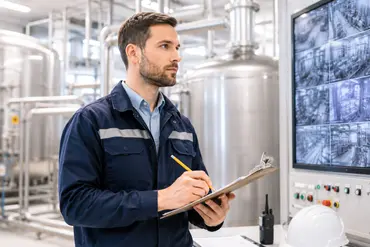
The surveillance of industrial plants is one of the most demanding tasks in the security sector. Here, high protection requirements, complex technology and strict legal regulations converge. We show which security aspects are decisive and which qualifications your employees must bring.
Why Industrial Plants Represent a Particular Challenge
Unlike an office building or a retail store, technical industrial plants have a number of special features:
| Special Feature | Example |
|---|---|
| High asset values | Machinery worth several million euros |
| Hazardous substances | Chemicals, gases, flammable liquids |
| Critical infrastructure | Electricity, water, district heating – failure would have far-reaching consequences |
| Large areas | Factory premises often several hectares, difficult to oversee |
| Complex access regulations | Different areas with different security levels |
| 24/7 operation | Shift work, including nights and weekends |
| Risk of sabotage & industrial espionage | Competitively relevant technologies |
The 7 Most Important Security Aspects in Industry
1. Access Control & Visitor Management
In a large-scale industrial plant, not every area is accessible to everyone. Modern access systems must:
- Assign personalized authorizations (who is allowed where?)
- Consider time windows (e.g. only during the shift)
- Record and escort visitors
- Provide external companies (maintenance, cleaning, suppliers) with temporary access
- Log access attempts (for later evaluations)
Practical tip: Use two-factor authentication for particularly sensitive areas (e.g. chip + PIN or chip + biometrics).
2. Plant Security & Perimeter Surveillance
The entire factory premises must be secured against unauthorized entry. This includes:
- Fences, gates, bollards as mechanical barriers
- Video surveillance of the perimeter (fences, entrances, parking lots)
- Motion detectors (vibration sensors on fences)
- Security lighting for night operations
- Regular patrol rounds by security personnel
3. Hazardous Substance Management
Many industrial plants store or process hazardous substances. Security surveillance must work particularly closely with the plant fire brigade and the hazardous substances officer.
- Access only for trained personnel to hazardous substance storage areas
- Leakage monitoring (sensors for gases, vapors, liquids)
- Emergency plans in the event of a release
- Documentation of all movements of hazardous substances
4. Fire Protection & Early Detection
Industrial plants have an increased fire risk due to:
- Electrical systems (overheating, short circuits)
- Chemical processes (exothermic reactions)
- Storage of flammable materials
- Welding and cutting work
Security measures:
- Fire alarm systems with automatic alerting
- Fire suppression systems (sprinklers, gas fire suppression systems)
- Regular fire safety inspections
- Fire brigade plans for emergencies
5. Monitoring of Critical Infrastructure
Certain plant components are particularly worthy of protection:
| Infrastructure | Risk in Case of Failure |
|---|---|
| Power supply | Shutdown of entire production |
| Control technology (PLC) | Malfunctions, production stoppages, hazards for employees |
| Cooling water supply | Overheating of systems, fire risk |
| Pressure vessels | Explosion risk |
| Server rooms | Loss of production data, control failures |
Security measures: Redundancy (dual execution), permanent monitoring of pressures, temperatures and fill levels, access restriction to absolutely necessary personnel.
6. Sabotage & Espionage Protection
Industrial plants are attractive targets for:
- Economic spies (theft of patents, production secrets)
- Saboteurs (targeted damage to systems)
- Cyber attackers (hacking into control systems)
Countermeasures:
- Security zones with staggered access authorizations
- Escorting of external companies in sensitive areas
- No private smartphones in production areas (photo ban)
- Regular security checks of employees (extended certificate of good conduct)
- IT security measures (firewalls, segmentation, updates)
7. Emergency Management & Alerting
In an emergency, all processes must seamlessly interlock:
- Alerting plan (who is alerted in which order?)
- Evacuation plans for employees and visitors
- Assembly points outside the danger zone
- Emergency drills (at least once a year)
- Communication between security service, plant fire brigade and external emergency services (police, fire brigade, rescue service)
What Training Do Surveillance Employees Need?
The surveillance of industrial plants requires far more than a standard security instruction. Here are the most important qualifications:
Basic Mandatory Training (Legally Required)
| Training | Content | Frequency |
|---|---|---|
| Expert examination §34a GewO | Legal bases, handling of weapons (only specific), de-escalation | Once, then further training every 5 years |
| Occupational safety instruction | Safety at the workplace, behavior in danger | Annually |
| Fire safety assistant | Extinguishing techniques, behavior in case of fire | Every 3-5 years |
| First aid training | Life-saving immediate measures | Every 2 years (9 units) |
Industry-Specific Training (Highly Recommended)
| Training | Content | Target Group |
|---|---|---|
| Hazardous substance instruction | Handling chemicals, gases, flammable liquids – recognizing hazardous situations | All employees with access to hazardous substance areas |
| Plant fire brigade basic training | Extinguishing fires in industrial plants, technical assistance | Security personnel with fire brigade duties |
| Access & visitor management | Operation of access systems, visitor guidance, ID checks | Gatekeepers, reception staff |
| De-escalation & conflict management | Dealing with aggressive visitors, resistance to access controls | All with customer contact |
| Detection of sabotage & industrial espionage | Typical methods, behavioral anomalies, reporting channels | Security personnel in sensitive areas |
| Emergency coordination | Alerting, evacuation, cooperation with authorities | Security management |
Technical Training (Plant-Specific)
| Training | Content |
|---|---|
| Operation of video surveillance | Panning, zooming, exporting recordings, legal limits |
| Operation of access control | Assigning, blocking authorizations, evaluating logs |
| Hazard alarm systems | Acknowledging fire alarms, intrusion alarms, fault messages |
| Internal communication systems | Plant radio, emergency call columns, announcements |
| Plant-specific special features | For example: recognizing unusual vibrations, noises or temperatures (only after instruction) |
Organizational Requirements
In addition to training, the organizational framework must also be right:
1. Shift Model
Industrial plants often operate 24/7. Your shift model must:
- Comply with working time laws (max. 10 hours/day, 48 hours/week)
- Consider break regulations
- Have regulated handovers between shifts (written handover protocols)
2. Documentation
Every security-relevant activity must be documented:
- Shift reports (incidents, special observations)
- Access logs (who was where and when?)
- Fault reports (alarms, technical defects)
- Training records (training)
3. Cooperation with External Parties
Industrial plants often work closely with external partners:
- Police (in case of crimes, sabotage)
- Fire brigade (in case of fires, hazardous substance accidents)
- Rescue service (in case of personal injury)
- Trade supervisory authority (in case of repeated safety deficiencies)
- Professional association (in case of work accidents)
Clear communication channels and operational procedures must be defined here.
Checklist for Security Managers in Industry
Check regularly:
- Are all access authorizations up to date (no former employees still in the system)?
- Are visitors and external companies consistently escorted?
- Are there regular security patrols (including outside regular working hours)?
- Are all cameras functional and correctly aligned (no blind spots)?
- Are the required training certificates available for all security employees?
- Are regular emergency drills conducted (including with external emergency services)?
- Is communication between security service, plant management and authorities regulated?
- Is there a procedure for reporting security incidents?
- Are security measures regularly reviewed for up-to-dateness (at least annually)?
Conclusion: Highest Demands on Personnel and Technology
Security surveillance in industrial plants of large-scale industry is not a standard job. It requires:
- Highest technical standards (access control, video, hazard alarm systems)
- Thoroughly trained personnel (beyond §34a)
- Close cooperation with plant fire brigade, authorities and plant operators
- Robust processes for emergencies
Invest in qualification, technology and organization – the safety of your employees, your systems and your production depends on it.
Do you need support with security planning for an industrial plant or are you looking for qualified security personnel with industrial specialization? We advise you discreetly, practically and with many years of experience in large-scale industry.
Note: This article does not replace individual security advice. The specific requirements depend heavily on the industry, the size of the plant and the hazardous substances present. An on-site risk assessment is essential.