
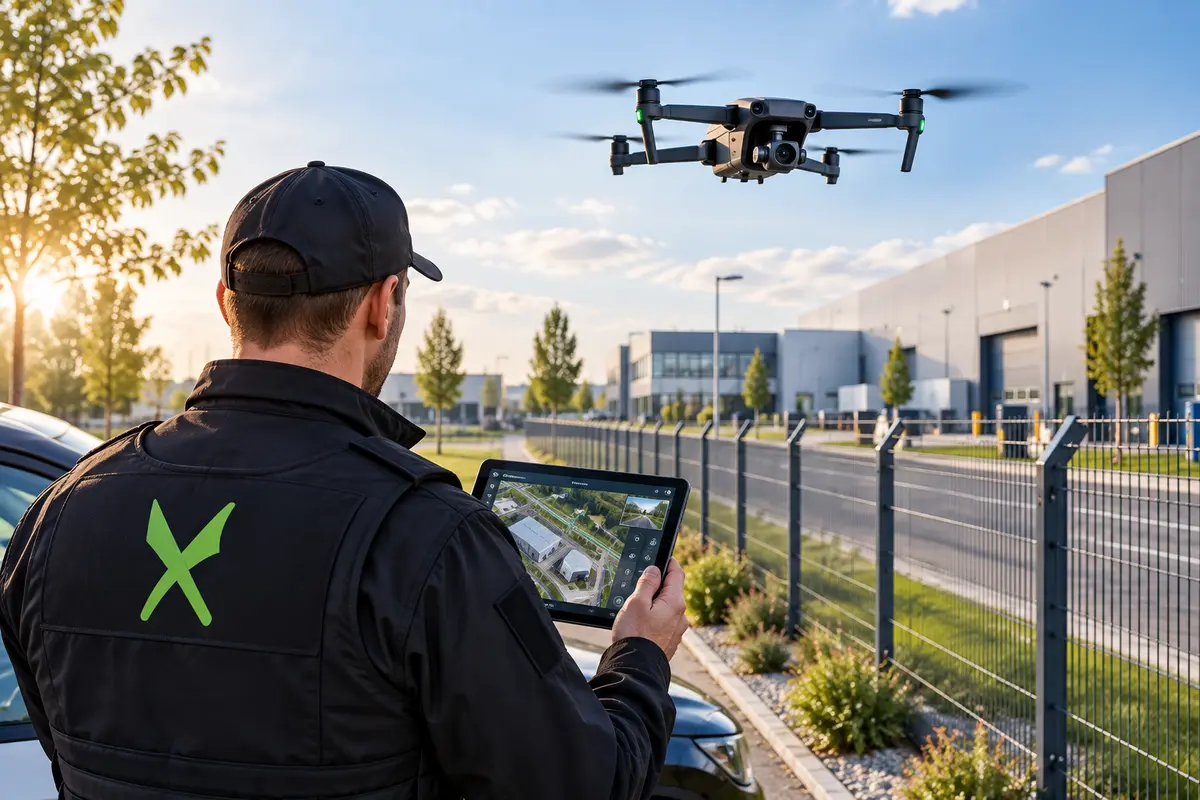
Legal Limits and Practical Applications
Within just a few years, drones have developed from recreational devices into powerful airborne sensor systems. Thermal imaging cameras, high-performance zoom optics, automated flight routes, precise satellite navigation and stationary docking systems now open up applications that are also of considerable interest to private security companies.
Their use is particularly compelling in the perimeter security of large sites. Industrial facilities, construction sites, logistics centres, solar parks, storage areas and other extensive premises can only be monitored by stationary cameras and personnel patrols with a corresponding level of effort. A drone, by contrast, can reach a remote alarm sector within a short time and provide security personnel with a current view of the situation.
But may a private security service in Germany actually use a camera-equipped drone for guarding purposes? What qualifications does the personnel require? May a drone launch automatically from a docking station? What happens when it flies beyond the pilot’s visual line of sight? And how can such surveillance be reconciled with data protection law?
The initial answer is clear: the use of drones by private security companies in Germany is possible in principle. There is, however, no general special permit for “security drones”. Instead, several areas of law intersect: private security law, European and German aviation law, data protection law, personality rights and, depending on the circumstances, other protective provisions.
What may appear to be the simple idea of a flying camera therefore becomes a demanding security concept.
A drone does not extend the powers of a private security service
For a private security company, the starting point remains Section 34a of the German Trade Regulation Act (Gewerbeordnung – GewO). Anyone who commercially guards the life or property of other persons requires the corresponding authorisation.
The use of a drone does not alter the legal nature of the guarding activity. It is initially a technical aid – comparable to stationary video technology, intrusion detection systems or other sensors.
Nor does its use create any additional sovereign powers. Section 34a(5) GewO limits the rights that private security companies and their employees may exercise against third parties essentially to rights available to everyone, particularly in connection with self-defence, necessity and self-help, contractual self-help rights transferred by the client and, where applicable, powers expressly conferred by law.
A security officer therefore does not become a police officer by using a drone, nor does the drone become a police surveillance instrument.
A professional system must consequently be designed, both technically and organisationally, to remain within the existing rights of the client and the security service.
Security officer and remote pilot are two different functions
An important distinction is necessary for practical operations.
An employee may act both as a security officer and as a remote pilot. The qualifications required for these functions, however, arise from two different areas of law.
Security activities are governed by Section 34a GewO and the German Guarding Ordinance (Bewachungsverordnung – BewachV). Security personnel must in particular be reliable and, as a rule, provide evidence of the required Chamber of Industry and Commerce (IHK) instruction; for the activities specifically identified by law, a proficiency examination is mandatory.
A person operating a drone additionally requires the remote-pilot competence prescribed for the particular UAS operation.
The proficiency examination under Section 34a GewO is therefore not a drone licence. Conversely, a remote-pilot certificate does not qualify a person to perform a regulated guarding activity.
A security company wishing to use drones professionally therefore needs personnel appropriately qualified for both areas – or an organisational separation between security personnel and specialised remote pilots.
Not every drone operation is legally the same
European drone law essentially distinguishes between three categories of operation:
Open, Specific and Certified.
The decisive factor is not primarily whether the drone is being used privately or commercially. What matters is the risk associated with the particular operation.
For a security service, both comparatively simple flights in the Open category and substantially more demanding operations in the Specific category may therefore be relevant.
Simple inspection flights in the Open category
An employee could, for example, launch a suitable drone on a manageable commercial site and use it to inspect a fence or an area in which an alarm has previously been triggered.
If the operation can be conducted within the requirements of the Open category, an individual operational authorisation under the Specific category is not required.
The fundamental limits of the Open category include, among other things, a maximum flight height of generally 120 metres above the closest point of the surface of the earth, compliance with the applicable subcategory and, most importantly, the general requirement to maintain direct visual line of sight with the unmanned aircraft (VLOS – Visual Line of Sight).
This last point is particularly important for perimeter security.
On a small commercial site, a VLOS operation may be entirely straightforward. On an industrial site several hundred metres long or a large solar park, however, visual contact can quickly be lost.
At that point, the aviation-law situation changes fundamentally.
Why A3 is not a simple solution for many security sites
At first glance, one might assume that large commercial sites could simply be flown in subcategory A3.
That is often not the case.
A3 requires, among other things, that the operation take place in an area where the remote pilot can reasonably expect that no uninvolved person will be endangered and provides for a horizontal safety distance of at least 150 metres from residential, commercial, industrial or recreational areas.
An industrial facility is, by its very nature, frequently located in an industrial or commercial area.
A3 is therefore by no means automatically suitable for typical industrial-site surveillance.
Depending on the aircraft and operating conditions, an operation with a C2 drone in A2 may, for example, be of greater interest. Special requirements then apply to distances from uninvolved persons and to the remote pilot’s qualification.
For a professional security company, every site must therefore be assessed from an aviation-law perspective before operations begin.
BVLOS – the decisive step towards professional perimeter security
The greatest potential arises when a drone is no longer used only in the immediate vicinity of its pilot.
Consider a large solar park. At 02:13, a sensor on the outer perimeter fence triggers an alarm. The relevant position is 700 metres from the security control room.
An employee could take a vehicle and inspect the area. Alternatively, a drone could launch from a docking station and reach the alarm sector within a short time.
The operator can see the aircraft’s position, telemetry and camera image on a screen. Because of the distance, darkness or buildings, however, the aircraft itself may no longer be directly visible.
This is fundamentally an operation beyond direct visual line of sight – BVLOS (Beyond Visual Line of Sight).
For many applications, this is precisely where the possibility of a simple Open-category operation ends.
Professional automated perimeter security therefore very quickly leads into the Specific category.
The Specific category is not a prohibition, but a different regulatory route
The fact that an operation falls within the Specific category does not mean that it is prohibited.
European regulation expressly provides procedures for such more demanding operations. Depending on the particular operation, a European standard scenario may be used, or an operational authorisation based on a risk assessment may be required.
This distinction is important for the professional security industry.
The correct statement is therefore not:
“BVLOS flights are prohibited for private security companies.”
It is:
BVLOS flights are possible in principle, but are subject to more extensive requirements than simple VLOS operations in the Open category.
STS-01 and STS-02
Two European standard scenarios exist for standardisable operations.
STS-01 concerns VLOS operations over a controlled ground area, which may also be located in a populated environment. A UAS bearing a C5 class identification label is specified for this scenario.
Of greater interest for perimeter security is STS-02.
This standard scenario permits BVLOS operation using a C6 UAS over a controlled ground area located entirely in a sparsely populated environment.
Subject to the conditions of the standard scenario, operations may extend up to one kilometre from the remote pilot without airspace observers, or up to two kilometres with airspace observers.
A remote solar park, a large open site or a comparable facility could therefore potentially be suitable for such a concept. A logistics centre in the middle of a densely developed commercial district, by contrast, cannot simply be placed under STS-02.
The prescribed controlled ground area, including the necessary safety areas, must also actually be capable of being established.
STS-02 is consequently an interesting route for certain security sites, but not a general authorisation for autonomous drone patrols in German industrial areas.
Training for STS operations
Remote-pilot qualification in the Specific category also goes beyond a basic certificate of competence.
STS operations require the corresponding theoretical remote-pilot qualification and practical training or assessment for the relevant standard scenario.
For STS-02, practical training expressly includes additional competences for BVLOS operations. These include flight planning, airspace assessment and site risk assessment as well as – where airspace observers are used – their positioning, communication and coordination.
For a security company, this means that anyone operating a professional BVLOS system should be treated as holding an independent safety-critical qualification, rather than simply giving a security officer a controller after a brief introduction.
When the standard scenario does not fit
A standard scenario will not exactly match many of the most interesting applications.
In that case, an individual operational authorisation in the Specific category may be considered.
The assessment of operational risk is central to this process. In this context, the SORA – Specific Operations Risk Assessment plays an important role.
The starting point is a detailed operating concept, often referred to as a ConOps – Concept of Operations.
This does not merely describe which drone is used. The entire operation must be considered: the operational area and airspace, flight routes and altitudes, persons on the ground, other possible air traffic, technical failures, loss of the command-and-control link, emergency procedures, personnel qualifications, organisational responsibilities and technical safety measures.
For certain operational profiles, PDRA – Predefined Risk Assessments are also available.
For a security service that intends to offer drone operations as a long-term service of its own, such a structured operating concept is considerably more professional than treating every flight as an isolated event.
Fully automated does not automatically mean legally permissible
Systems are already technically available in which a drone launches independently from a weather-protected station, flies a pre-programmed route, transmits images, returns, lands and is then recharged automatically.
From an aviation-law perspective, however, this technical automation must not be taken to mean that the operation may take place without a responsible remote pilot.
Standard scenarios and predefined risk assessments likewise contain clear requirements concerning human control.
In particular, automation must not simply be equated with autonomous operation.
For a private security service, the more realistic model at present is therefore not a completely self-directed “robot guard”, but a highly automated UAS whose mission is supervised by qualified personnel and for which defined intervention options and emergency procedures exist.
German geographical UAS zones must also be taken into account
The European operating category alone does not answer whether a flight may take place at a particular location.
In Germany, Section 21h of the Air Traffic Regulations (Luftverkehrs-Ordnung – LuftVO), in particular, contains rules concerning geographical UAS zones.
This may affect precisely the types of customers typically served by security companies. Relevant areas may include locations close to aerodromes, transport infrastructure, certain public authorities, hospitals, industrial facilities or other specially protected installations.
This leads to an important principle:
The property owner’s consent does not replace an aviation-law assessment.
The mere fact that a client owns a large industrial site does not automatically permit every conceivable drone operation above that site.
A site-specific UAS risk assessment should therefore be conducted before drone guarding operations commence.
Operator registration, identification and liability insurance
In addition to the remote pilot’s qualification, a distinction must be made between the pilot and the UAS operator.
In a professional security concept, the company would typically act as the UAS operator, while individual qualified employees would act as remote pilots. European registration requirements apply depending on the operation. A security company should therefore establish a centralised UAS operation rather than allowing individual employees to deploy drones independently.
Drones are also aircraft. Section 43 of the German Aviation Act (Luftverkehrsgesetz – LuftVG) generally requires the aircraft keeper to maintain liability insurance covering aviation-law liability.
For a security company, it is important not to confuse aviation liability insurance with the ordinary business liability insurance used in the security industry. Before deployment, it must be verified that the insurance actually covers the particular commercial drone operation, including the intended operational profile.
The second major boundary: data protection
A drone operation that is technically and legally permissible under aviation law may nevertheless be unlawful under data protection law.
As soon as a camera records identifiable individuals, personal data may be processed. This does not concern faces alone. Vehicle registration plates, clothing, movement patterns or a combination of location, time and other information can also make a person identifiable.
Private security companies must therefore take particular account of the General Data Protection Regulation (GDPR) and the German Federal Data Protection Act (Bundesdatenschutzgesetz – BDSG).
Video surveillance of publicly accessible areas
Section 4 BDSG contains specific requirements for video surveillance of publicly accessible areas.
Such observation may, among other things, be permissible for exercising the right to determine who shall be allowed or denied access, or for pursuing legitimate interests for specifically defined purposes, provided that it is necessary and there are no overriding legitimate interests of the data subjects.
A drone makes this balancing exercise more complicated than a permanently mounted camera. It continuously changes its position, altitude and viewing angle and can see over fences, walls and other visual barriers.
Its camera operation must therefore be limited with particular care.
Alarm verification instead of permanent surveillance
One particularly interesting model for private security services is therefore event-driven alarm verification.
A drone does not have to circle a site permanently. Instead, it can form part of a layered security architecture:
Perimeter sensors → alarm → drone reconnaissance → human assessment → intervention
A fence sensor or stationary camera may, for example, detect an anomaly at night. Only then is the drone deployed. It flies specifically to the affected sector and provides the employee in the security control room with a current view of the situation.
The drone thus becomes a mobile sensor for alarm verification, rather than an instrument for continuous, comprehensive surveillance of individuals.
From the perspective of proportionality and data minimisation, this approach is considerably more convincing.
Thermal imaging as the first sensor layer
Thermal imaging cameras are particularly interesting for this purpose.
In complete darkness, a thermal camera can detect people or vehicles without initially requiring a conventional high-resolution colour image.
Thermal images are not automatically exempt from data protection law. They too can constitute personal data. Nevertheless, a sensible sensor hierarchy can help to reduce the amount of data processed:
Alarm → thermal detection → human verification → optical camera only where required.
Only when an actual security-relevant event has been confirmed might the operator, for example, use an optical camera or zoom function.
Privacy by Design for security drones
A professional drone system should not regulate data protection solely through staff instructions.
Possible measures include geofencing for the permitted flight area, predefined camera angles, digital privacy masks for neighbouring properties, exclusion of certain public traffic areas, restricted zones around residential buildings and windows, recording disabled by default, event-based storage, short retention periods, role-based access rights, logging of camera and data access, and encrypted transmission.
Where technically possible, sensitive areas should in particular be blocked by technical means.
That is considerably more robust than a mere instruction saying:
“Please do not zoom in on the neighbouring property.”
Data Protection Impact Assessment
In cases involving extensive systematic monitoring of publicly accessible areas, a Data Protection Impact Assessment (DPIA) may be required under Article 35 GDPR.
A professional drone project should therefore assess during the planning stage whether a DPIA is necessary. Among other things, it examines the purpose and scope of processing, necessity and proportionality, risks to affected persons, and technical and organisational measures for reducing those risks.
Who is the data controller?
The relationship between the client and the security service must also be clarified.
The decisive question is, in particular, who determines the purposes and means of the processing. Depending on the contractual arrangements and actual decision-making structure, different roles under data protection law may arise.
Before operations commence, the purpose of the video surveillance, camera areas, retention periods, access rights, handling of data-subject requests, export of recordings, deletion and any disclosure to investigating authorities must therefore be defined.
Which drones are suitable for perimeter security?
The requirements of a professional security service differ considerably from those of a recreational pilot.
Important characteristics include a thermal imaging camera, a capable low-light camera, optical zoom, reliable obstacle detection, weather resistance, precise GNSS/RTK positioning, an appropriate EU class identification label, automated mission planning, secure data transmission, interfaces to the security control centre, centralised user administration and, for automated operations, a suitable docking station.
Example: DJI Matrice 4TD with Dock 3
One technically interesting example is the DJI Matrice 4TD in combination with DJI Dock 3.
The Matrice 4TD combines several optical cameras with a thermal imaging camera, NIR auxiliary light and a laser rangefinder. The platform is designed for industrial applications and automated dock operation.
Of particular interest for European operations is its class identification: the Matrice 4D series can be operated as C2; in the intended configuration with Dock 3, the system also has a C6 classification.
This provides precisely the class of aircraft that may be relevant to an operation under STS-02.
It expressly does not mean that purchasing a C6 drone automatically permits BVLOS operation. Drone class, remote-pilot qualification, operator obligations, operating environment and all conditions of the standard scenario must be satisfied together.
Drone-in-a-Box
The combination of a drone and an automated docking station is particularly interesting for security services.
Such a system can receive a mission command, open the station, launch automatically, fly a predefined route, transmit live images, return to the dock, land automatically and then recharge for the next deployment.
The principal advantage is not necessarily the replacement of human security personnel.
Far more significant is the reduction in the time between an alarm and the first reliable assessment of the situation.
A realistic operational scenario
Consider a 30-hectare solar park.
At 02:13, a perimeter sensor on the north-eastern fence triggers an alarm. The relevant sector is approximately 700 metres from the security control room.
With a conventional solution, a security officer would first have to take a vehicle and drive to the alarm area.
With an integrated drone system, a qualified operator could approve the prepared mission after the alarm has been checked. The drone launches from the dock, follows a previously defined safe route to the alarm area and initially provides thermal imagery.
If a heat source approximately corresponding to a person is detected, the operator may – where necessary and legally permissible – switch to the optical camera. If the presence of a person inside the protected area is confirmed, security personnel and, where appropriate, the police can respond far more precisely.
The drone has not replaced the security officer.
It has provided that officer with a current situational picture within a matter of minutes.
Information security must not be overlooked
A professional system can contain information about the layout and structure of a site, flight and patrol routes, camera positions, alarm zones, fence lines, security areas, deployment times, employee movements and potentially critical infrastructure.
The drone platform itself therefore becomes an IT system requiring protection.
For a security company, camera quality alone should consequently not determine the choice of manufacturer.
At least equally important are questions concerning where video and telemetry data are stored, whether local operation is possible, cloud dependencies, administrative access, authentication, encryption, roles and permissions, logging, firmware updates, network segmentation and documented interfaces to the company’s own security control-centre software.
The drone as part of a layered security concept
A drone’s greatest strength does not lie in completely replacing existing security systems.
Its value is instead realised as an additional layer:
1. Detection: Fence sensors, radar, light barriers, stationary video analytics or other sensors identify a possible event.
2. Verification: Stationary cameras and, where necessary, a drone provide a current view of the situation.
3. Assessment: A qualified security officer decides whether an actual security incident exists.
4. Intervention: Security personnel, an intervention service, the fire brigade or the police are deployed according to the situation.
This does not create an autonomous “robot guard”, but rather a technologically enhanced security system in which the human remains the decisive authority.
Particularly suitable fields of application
Not every guarded property justifies the expense of a drone solution.
The technology appears particularly interesting for solar parks and energy facilities, industrial and factory premises, logistics centres, construction sites, open areas, material storage sites and other large properties where long distances or difficult-to-see areas delay conventional alarm verification.
At remote sites, the aviation-law conditions may also be more favourable than in densely developed urban areas.
Where the limits lie
Despite their technical capabilities, drones are not universal surveillance instruments.
Operations may be problematic or unlawful in particular where public traffic areas, neighbouring properties, private gardens or residential areas are recorded without an adequate legal basis.
Nor may a drone be used for general observation of arbitrary persons merely because they happen to be near a guarded site.
A technically available zoom function is not automatically a legally permissible zoom function.
From a drone to UAS security management
A security company wishing to use this technology professionally should therefore not simply “buy a drone”.
A more appropriate approach would be to establish a dedicated UAS security management system covering four areas:
Private security law: Section 34a GewO, BewachV, staff powers, operating instructions and the client’s contractual rights.
Aviation: operator registration, remote-pilot qualifications, UAS classes, Open/Specific, STS, where applicable SORA/PDRA, geographical UAS zones, insurance, maintenance and emergency procedures.
Data protection: GDPR, BDSG, responsibilities, where applicable a Data Protection Impact Assessment, information obligations, camera areas, deletion policy, privacy masks and access control.
Information security: encryption, network segmentation, local or cloud storage, roles and permissions, logging, update and vulnerability management, and protection of the UAS infrastructure against manipulation.
Only the combination of these four levels turns a technically capable drone into a professional security tool.
Conclusion
The use of drones in the private security industry in Germany is possible in principle, provided that the specific operation is properly planned and conducted.
The real challenge is not a general prohibition, but the interaction of several different areas of law.
For manageable manual inspection flights, the Open category may be sufficient under suitable conditions.
As soon as large sites are to be monitored in an automated manner and the aircraft operates beyond the remote pilot’s direct visual line of sight, the Specific category becomes central. For suitable operating environments, STS-02 provides a European regulatory framework for C6 UAS and BVLOS operations. Other operational profiles may require more extensive operational authorisations and risk assessments.
At the same time, video surveillance must be permissible under data protection law and limited to what is necessary.
For precisely this reason, the most interesting model for private security companies does not appear to be permanent airborne video surveillance, but rather event-driven drone reconnaissance for alarm verification.
The drone is then launched not to collect as much imagery as possible, but because a specific security system has triggered an alarm. Thermal imaging can initially provide situational detection; optical cameras are used only to the extent required for further assessment.
Combined with geofencing, privacy masks, short retention periods, secure data paths and qualified personnel, this can create a technically and legally well-designed system.
The drone replaces neither the security officer nor the officer’s decision.
Instead, it shortens the path between alarm and situational awareness.
And that may prove to be its greatest significance for the future of perimeter security.
Legal Framework and Further Sources
When planning a specific UAS operation, the current versions of the relevant legislation and official guidance should always be consulted. The most important sources include:
- German Trade Regulation Act (Gewerbeordnung – GewO), in particular Section 34a – authorisation, requirements and powers in the private security industry: https://www.gesetze-im-internet.de/gewo/__34a.html
- German Guarding Ordinance (Bewachungsverordnung – BewachV) – supplementary requirements for security companies and security personnel: https://www.gesetze-im-internet.de/bewachv_2019/
- Commission Implementing Regulation (EU) 2019/947 – European rules and procedures for the operation of unmanned aircraft, including the Open and Specific categories and standard scenarios: https://eur-lex.europa.eu/eli/reg_impl/2019/947/oj
- Commission Delegated Regulation (EU) 2019/945 – requirements for unmanned aircraft systems and European UAS classes: https://eur-lex.europa.eu/eli/reg_del/2019/945/oj
- EASA – Easy Access Rules for Unmanned Aircraft Systems – consolidated European UAS rules and guidance: https://www.easa.europa.eu/en/document-library/easy-access-rules/easy-access-rules-unmanned-aircraft-systems-regulations-eu
- EASA – Standard Scenarios (STS) – information on STS-01 and STS-02: https://www.easa.europa.eu/en/domains/drones-air-mobility/operating-drone/specific-category-civil-drones/standard-scenario-sts
- German Air Traffic Regulations (Luftverkehrs-Ordnung – LuftVO), in particular Section 21h – German geographical UAS zones and special operating requirements: https://www.gesetze-im-internet.de/luftvo_2015/__21h.html
- German Aviation Act (Luftverkehrsgesetz – LuftVG), in particular Section 43 – liability insurance: https://www.gesetze-im-internet.de/luftvg/__43.html
- General Data Protection Regulation (GDPR), in particular Articles 5, 6, 13 and 35 – principles, legal bases, information obligations and Data Protection Impact Assessments: https://eur-lex.europa.eu/eli/reg/2016/679/oj
- German Federal Data Protection Act (Bundesdatenschutzgesetz – BDSG), in particular Section 4 – video surveillance of publicly accessible areas: https://www.gesetze-im-internet.de/bdsg_2018/__4.html
- German Data Protection Conference (DSK) – position paper on the use of camera drones by non-public bodies – data protection assessment of the particular risks associated with camera-equipped drones: https://www.datenschutzkonferenz-online.de/media/oh/20190116_oh_positionspapier_kameradrohnen.pdf
Depending on the specific operation, further aviation-law, data-protection, employment-law or local requirements may apply. In particular, for BVLOS operations, automated docking systems or sensitive sites, the operating concept should undergo specialist and legal review before regular operations commence.
Note: This article provides a general overview of technical and legal aspects of drone use in the private security industry. It does not constitute legal advice. The permissibility of a specific operation depends in particular on the location, airspace, UAS used, type of operation, surveillance purpose and local circumstances and must be assessed on a case-by-case basis.